

TechnologyFeb 12, 2026
Hydrogen Cartridge Technology: How It Works
How hydrogen cartridges store and deliver fuel for portable fuel cells. Covers safety, shelf life, RFID monitoring, and field use.
5 min read
The Fuel Problem Hydrogen Cartridges Solve
Hydrogen gas is the fuel. But storing and transporting hydrogen has historically been the biggest barrier to portable hydrogen power. High-pressure tanks are heavy. Liquid hydrogen requires cryogenic temperatures.
Hydrogen cartridges solve this by packaging hydrogen fuel in lightweight, sealed, swappable units designed for field use. Think of them like ammunition magazines for a fuel cell: standardized, quick to swap, and engineered for rough handling.
How Hydrogen Cartridges Work
A hydrogen cartridge stores hydrogen in a form that can be safely transported, stored for years, and released on demand to a fuel cell.
The cartridge connects to a fuel cell generator through a standardized interface. When the fuel cell needs hydrogen, the cartridge releases fuel at a controlled rate. When the cartridge is empty, you pull it out and insert a fresh one.
No tools. No training beyond basic familiarization. No specialized infrastructure.
Key Specifications
RFID Smart Monitoring
Each cartridge contains an embedded RFID chip that tracks:
This data can be read by the fuel cell system automatically or by handheld RFID readers during inventory management. For military logistics, this level of tracking is standard practice applied to a new fuel type.
- 01
Fuel level - How much hydrogen remains
- 02
Usage history - When and where the cartridge has been used
- 03
Manufacturing data - Production date, batch number, certification
- 04
Health status - Any anomalies detected during use
Safety Engineering
Hydrogen cartridges are engineered with multiple safety layers:
Compare this to a jerry can of diesel: flammable liquid that spills, ignites, and contaminates soil. Hydrogen cartridges are inherently safer to store and transport.
- 01
Leak-proof seals - Multiple redundant seals prevent hydrogen release during storage and transport
- 02
Pressure relief - Controlled venting prevents over-pressurization in extreme heat
- 03
Impact resistance - Tested to military drop and vibration standards
- 04
Fire resistance - Cartridge construction withstands external fire exposure
- 05
Tamper evidence - Visual indicators show if a cartridge has been compromised
Logistics Advantages
Pre-Positioning
With a 15-year shelf life, hydrogen cartridges can be pre-positioned at forward operating bases, disaster staging areas, and remote sites years before they're needed. Diesel fuel degrades in 6-12 months.
Weight
Hydrogen cartridges are lighter per unit of energy than diesel fuel containers. A single soldier can carry enough cartridges for days of power.
No Contamination
Hydrogen cartridges don't leak flammable liquid. No soil contamination. No environmental cleanup. No fire hazard from pooling fuel.
Simplified Supply Chain
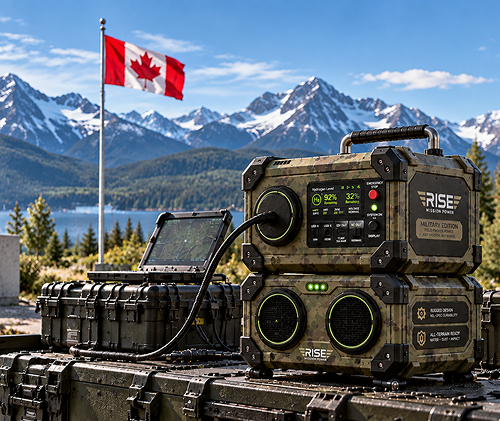
Standardized cartridges mean one fuel format across all compatible systems. The Rise-Sentinel, Rise-Falcon, and Rise-Titan all use the same cartridge platform.
Field Use Procedure
Total time: under 30 seconds. No tools. Glove-compatible.
- 01
Check the RFID indicator on the current cartridge (or check the fuel cell's status display)
- 02
Release the cartridge using the quick-disconnect mechanism
- 03
Remove the spent cartridge
- 04
Insert a fresh cartridge until it clicks into place
- 05
The fuel cell resumes power generation automatically
Storage and Transport
Hydrogen cartridges are classified for standard ground and air transport. They can be stored in standard supply warehouses, shipped in standard containers, and handled with standard materials handling equipment.
No special storage facilities. No temperature-controlled environments (within the -40°C to 60°C range). No hazardous materials handling beyond standard precautions.
Learn more about Rise Power's hydrogen cartridge system
FAQ
How many times can a hydrogen cartridge be refilled?
Current cartridges are designed as single-use units that are returned for refilling at authorized facilities. This ensures quality control and safety certification for each fill cycle. The cartridge body itself is designed for multiple refill cycles.
Can hydrogen cartridges explode?
Hydrogen cartridges are engineered with multiple safety systems to prevent catastrophic failure. Pressure relief valves vent hydrogen safely before dangerous pressures can build. The cartridges are tested to military standards for impact, vibration, and thermal exposure.
How do you dispose of empty hydrogen cartridges?
Empty cartridges are returned through a reverse logistics program for refilling and reuse. They are not disposable waste. The cartridge body is designed for a long service life across many fill cycles.
Are hydrogen cartridges compatible across different fuel cell systems?
Rise Power's cartridge system uses a universal interface designed for compatibility across the full product line. The same cartridges work with the Rise-Sentinel portable unit, the Rise-Falcon drone extender, and the Rise-Titan generator.
What does RFID monitoring tell you about a cartridge?
The RFID chip reports fuel level, usage history, manufacturing data, and health status. This enables automated inventory management, predictive logistics, and quality tracking across the supply chain.
Related