
ApplicationsNov 1, 2025
Off-Grid Power Solutions for Remote Sites
Compare diesel, solar, battery, and hydrogen fuel cell solutions for off-grid power. Find the right fit for remote sites, camps, and field operations.
4 min read
Remote Sites Need Power That Doesn't Need Babysitting
Off-grid power is a solved problem if you're willing to accept the compromises. Diesel generators work but need fuel deliveries and constant maintenance. Solar works but not at night or in bad weather. Batteries work but run out. Hydrogen fuel cells work around the clock, in any weather, with minimal maintenance and zero emissions.
This guide covers every practical off-grid power option and helps you choose the right one for your site.
Off-Grid Power Options Compared
Remote Site Categories
Temporary Field Camps (Days to Weeks)
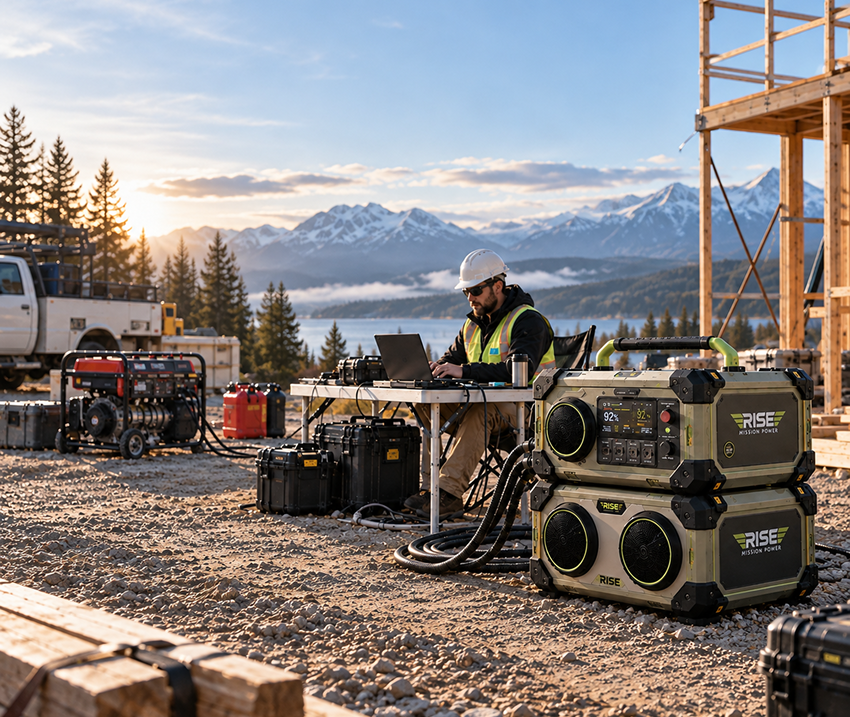
Construction staging areas, disaster response camps, military patrol bases, and film sets need power that deploys fast and packs out clean. Weight and setup time matter most.
Best option: Hydrogen fuel cells. The Rise-Titan generator sets up in minutes, runs quietly, and leaves zero environmental trace. No fuel spill risk, no emissions reporting.
Semi-Permanent Remote Sites (Weeks to Months)
Mining exploration camps, pipeline monitoring stations, environmental research sites, and forward operating bases need sustained power with infrequent resupply.
Best option: Hydrogen fuel cells as primary, with solar panels as supplementary charging. The combination minimizes resupply frequency while maintaining 24/7 reliability.
Permanent Off-Grid Installations (Years)
Telecom towers, weather stations, remote sensors, and surveillance systems need maintenance-free power for extended periods.
Best option: Solar + battery for sites with reliable sun. Hydrogen fuel cells for sites with poor solar resources, extreme cold, or where uptime requirements exceed what solar can guarantee.
Sizing Your Off-Grid Power System
Step 1: Calculate Load
List every device and its power draw. Multiply watts by hours of daily use.
Step 2: Add Safety Margin
Add 25% to your calculated load for inefficiencies, peak loads, and future expansion.
Step 3: Match to Platform
Cold Climate Considerations
Off-grid sites in northern Canada, Arctic regions, or high altitude face unique challenges. Solar output drops 50-70% in winter months due to short days and low sun angles. Lithium batteries lose 20-40% capacity below -10°C and risk permanent damage below -20°C.
Hydrogen fuel cells operate to −22°C and generate waste heat that can be captured for equipment warming. The Rise-Titan's operating range of −22°C to +50°C covers virtually every inhabited climate zone on Earth.
Logistics Comparison
Getting fuel to remote sites is often the biggest cost and risk factor. Here's how the options compare:
Environmental and Regulatory Advantages
Many remote sites are in environmentally sensitive areas -- national parks, watersheds, Indigenous lands, marine environments. Diesel generators require spill containment plans, emissions permits, and environmental impact assessments. Hydrogen fuel cells require none of these because they produce zero emissions and zero liquid waste.
In Canada, the Impact Assessment Act increasingly scrutinizes diesel use in remote operations. Hydrogen fuel cells provide a compliance-friendly alternative that simplifies permitting.
FAQ
Can hydrogen fuel cells power a full base camp?
Yes. Multiple Rise-Titan units can be networked (for example, about 1.5–7.5 kW with 1–5 units). That covers lighting, communications, computing, refrigeration, and small HVAC loads for camps up to 50 people.
How do you get hydrogen cartridges to truly remote sites?
The same logistics used for any critical supply. Helicopter sling load, fixed-wing airdrop, snowmobile, ATV, or pack animal. Hydrogen cartridges are lighter per unit of energy than diesel fuel and classified for air transport.
What's the cost comparison between diesel and hydrogen for off-grid power?
Diesel fuel costs $1.50-3.00/L at the pump but $10-50/L delivered to remote sites when you factor in transport. Hydrogen cartridge costs are competitive with delivered diesel and include zero environmental compliance overhead. Contact us for a site-specific cost comparison.
Can I combine hydrogen fuel cells with solar panels?
Absolutely. Solar handles daytime base load while hydrogen covers nights, cloudy days, and peak demand. This hybrid approach reduces hydrogen consumption by 30-60% depending on solar resources.
Do hydrogen fuel cells work in humid tropical environments?
Yes. PEM fuel cells actually perform slightly better in humid conditions because the membrane stays naturally hydrated. The Rise-Titan operates from −22°C to +50°C across all humidity levels.
Related