
ComparisonAug 15, 2025
Portable Generator Comparison: Every Type Ranked
Compare diesel, gas, propane, solar, battery, and hydrogen portable generators on noise, weight, runtime, emissions, and cost. Full comparison table.
3 min read
Six Generator Types, One Clear Winner for Each Use Case
Choosing a portable generator means choosing a set of tradeoffs. Diesel gives you raw power but weighs a ton. Solar is free but disappears at sunset. Batteries are silent but run out. This guide compares every portable generator type side by side so you can match the right technology to your application.
The Complete Comparison
Diesel Generators
Strengths
Weaknesses
Best for
Construction sites, industrial backup power, large event support where noise and emissions aren't concerns.
Gasoline Generators
Strengths
Weaknesses
Best for
Home backup, tailgating, RV camping, occasional use where fuel storage isn't a concern.
Propane Generators
Strengths
Weaknesses
Best for
Home standby, off-grid cabins, applications where fuel storage longevity matters but power demand is moderate.
Solar + Battery Systems
Strengths
Weaknesses
Best for
Long-term off-grid installations with good sun, environmentally sensitive areas, permanent residential off-grid systems.
Battery-Only Power Stations
Strengths
Weaknesses
Best for
Short events, apartment backup, quiet outdoor activities, supplementing other power sources during peak loads.
Hydrogen Fuel Cells
Strengths
Weaknesses
Best for
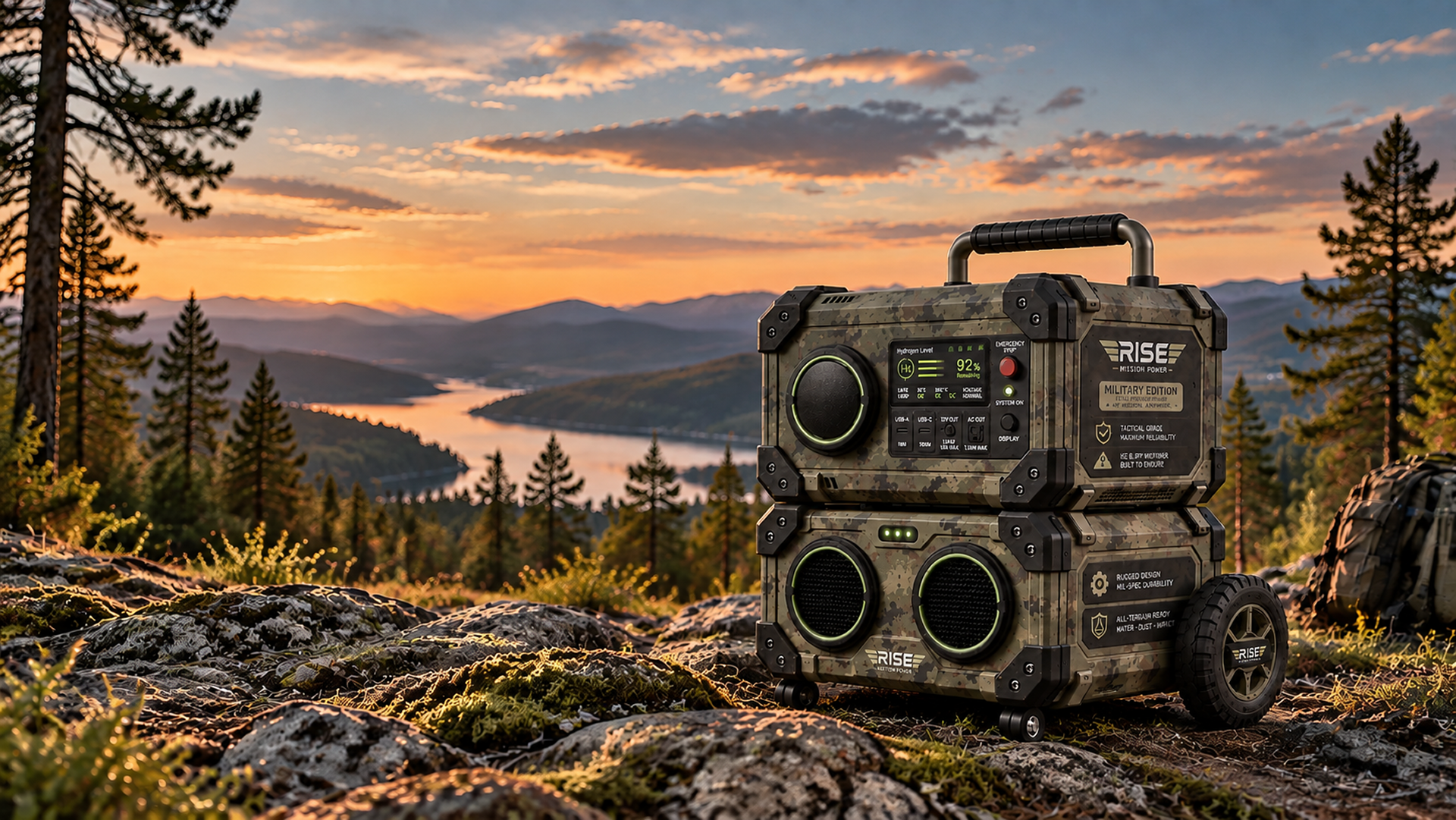
Military and defence, emergency response, noise-sensitive operations, environmentally sensitive sites, cold-weather operations, extended off-grid deployments. Explore Rise Power's lineup.
Choosing by Application
The Trend Line
The portable generator market is shifting. Diesel and gasoline generators face increasing regulation on emissions and noise. Battery technology improves annually but fundamental chemistry limits runtime. Solar is proven but weather-dependent.
Hydrogen fuel cells sit at the intersection of all the qualities modern users need: clean, quiet, lightweight, long-running, and weather-independent. As hydrogen cartridge production scales and costs decrease, expect fuel cells to capture market share across every application above.
For defence, emergency management, and critical infrastructure, hydrogen fuel cells aren't just competitive. They're the best available option today. See Rise Power's full product line or contact our team for a consultation.
FAQ
What's the quietest portable generator?
Battery-only power stations produce zero noise. Among fuel-burning generators, hydrogen fuel cells are quietest at under 65 dBA. Inverter gasoline generators like the Honda EU2200i claim 48-57 dBA at quarter load. Read our detailed noise comparison.
Which generator type has the lowest total cost of ownership?
For short-term use (under 1 year), gasoline generators have the lowest TCO. For 1-5 year deployments, propane and hydrogen compete depending on fuel delivery costs. For 5+ years of stationary use, solar-plus-battery has the lowest TCO in sunny climates.
Can any of these generators power a house?
Diesel and gasoline generators in the 5-10 kW range can power most household loads. Propane standby generators are the most common home backup solution. Battery stations handle essentials for a few hours. Portable hydrogen fuel cells like the Rise-Titan deliver 1.5 kW, sufficient for critical loads but not whole-house.
Which generator is safest to use indoors?
Only battery-only systems and hydrogen fuel cells are safe for indoor use. All combustion generators (diesel, gasoline, propane) produce carbon monoxide and must never be operated indoors or in enclosed spaces. Hydrogen fuel cells produce only water vapor and warm air.
What about dual-fuel and tri-fuel generators?
Dual-fuel (gasoline/propane) and tri-fuel (gasoline/propane/natural gas) generators offer fuel flexibility at the cost of added complexity. They're useful for home backup where you might have propane on hand and gasoline as backup. For professional and military applications, the added complexity usually isn't worth the flexibility.
Related